"We can no longer afford for-profit health care in this state," said Randy Phillis, a faculty member of the biology department at UMass Amherst. "It is literally sucking the life out of all of us and it is a huge waste of money."
Published on GazetteNET (http://www.gazettenet.com)
Source URL: http://www.gazettenet.com/2010/05/18/lawmakers-see-no-chance-reversing-state-aid-cuts
Lawmakers see no chance of reversing state aid cuts
By Owen Boss Created 05/18/2010 - 04:17
NORTHAMPTON - Supporters of a Proposition 2½ override seeking a boost in state aid to cities and towns got little encouragement from area legislators at a meeting Monday night.
More than 60 people turned out for the meeting, which was sponsored by Yes!Northampton, a nonprofit group that emerged in support of recent Proposition 2½ overrides in the city, at the Community Room at JFK Middle School. Many called on Sen. Stan Rosenberg, D-Amherst, and Rep. Peter Kocot, D-Northampton, to support bills that would restore the state tax rate on income and dividends to 12 percent, while exempting income of seniors, a plan members said would generate an estimated $500 million a year, almost exclusively from those at the top 5 percent of Massachusetts earners.
Although both Rosenberg and Kocot said that kind of legislation would help ease budget shortfalls on cities and towns statewide, they said the idea was not realistic given the commonwealth's current political climate. Kocot said the current budget crisis is bigger than any other in the recent past.
"The last two recessions, which were both described as the worst recessions since the Great Depression, lasted four and five years respectively and during those two recessions we had between a $4 billion and $6 billion problem," Kocot said. "Last year alone we dealt with a $5 billion gap and over the 22 months since the beginning of this recession, we've had a $9 billion problem to solve. This is beyond anything that we have ever faced."
Before passing out a documented roll call vote showing that only nine of 160 House member supported legislation to restore the tax rate to 12 percent, Kocot explained how legislators bridged a $5 billion budget gap in last year's budget and how they plan to close an estimated $2.7 billion in the upcoming fiscal year.
"I don't want to raise anyone's taxes. That is not the fun part of my job. But clearly, every community has needs and we need to raise additional revenues just to fund the basic services that we offer," Kocot said. "Clearly, 9/11, the meltdown on Wall Street, the wars that we have been waging in Afghanistan and Iraq have all diverted a great amount of revenue from this community and from the commonwealth."
Rosenberg shared Kocot's belief that an income tax increase would be extremely difficult to pass in the state Senate and referenced a similar vote this year to restore the state income tax to 5.7 percent.
"We had 11 out of 40 senators who voted in favor of that bill," Rosenberg said. "So the analysis that Peter gave you is a essentially consistent with what happened in the Senate and with what we can conceive happening going forward."
Rosenberg also mentioned that many state senators have vowed not to vote for new taxes in the 90 days remaining in the current term and others have said they won't vote for new taxes until the debate surrounding expanded gaming in the commonwealth is resolved.
"The problem there is that expanded gaming, if it passes, would mean we would see revenue 18 to 24 months down the road at a minimum," Rosenberg said. "Casinos or slot machines at race tracks are not going to save our hides for Fiscal '11 and the revenues they would generate would barely be visible on the budget for Fiscal '12."
Another problem with passing the legislation in time for this year's budget, Rosenberg said, is that the Senate can't enact new taxes or tax increases because the House didn't address taxes, and "all money bills and revenue bills by law have to start in the House."
Mayor Clare Higgins praised Kocot's and Rosenberg's efforts to limit reductions in state aid but drew applause from the crowd when she said not enough has been accomplished with the city facing a $480,000 cut in state aid.
"We all have to take it upon ourselves to call our state legislators and to ask them to look at how we do this because I think the whole system is fundamentally broken and I don't think it works anymore." Higgins said. "The amount of state revenue that comes back to us doesn't cover the base-line costs for things people expect to get on a local level, including street lighting, street paving, education and public safety. We can't afford to do all of those things with the amount of money coming in."
Other ideas raised at the meeting included eliminating the sales tax exemption on candy, soda, which could generate an estimated $51.7 million annually for public health programs; ending the tax exemption on cigars, smoking and smokeless tobacco; and taxing revenues generated at hospitals statewide.
"We can no longer afford for-profit health care in this state," said Randy Phillis, a faculty member of the biology department at UMass Amherst. "It is literally sucking the life out of all of us and it is a huge waste of money."
Owen Boss can be reached at oboss@gazettenet.com
Daily Hampshire Gazette © 2010 All rights reserved
Photos here:
http://www.facebook.com/album.php?aid=61893&id=1354127943
http://www.facebook.com/avbrewer
I can't find Yes!Northampton's url for some silly reason (voteyesnorthampton.org dead), but here's the Amherst:
http://voteyesforamherst.org/
--------------------------------------------------------
Published on GazetteNET (http://www.gazettenet.com)
Source URL: http://www.gazettenet.com/2010/05/15/residents-have-say-over-state039s-budget-priorities
Northampton residents to have say over state's budget priorities
By Chad Cain Created 05/15/2010 - 05:00
NORTHAMPTON - Most of Hampshire County's state legislators will pay a visit to Paradise City Monday to discuss the state budget crisis and outline steps they are taking to help communities through one of the most difficult financial times in years.
Sen. Stan Rosenberg, D-Amherst, and Reps. Peter Kocot, D-Northampton, and Ellen Story, D-Amherst, will talk about the budget and its impact on Northampton and Amherst. They also will detail solutions that exist at the state level and tout initiatives that they have put forward.
Yes!Northampton and Yes for Amherst, two fledgling groups that emerged in support of recent Proposition 2½ overrides in their communities, are sponsoring the 90-minute discussion that begins at 7 p.m. in the JFK Middle School Community Room. Northampton Mayor Clare Higgins and other elected officials will also attend.
The Yes groups are following through on promises to continue to fight to attain revenue from state and federal resources following the successful passage of overrides. They are working with One Massachusetts to develop a statewide campaign that has pushed for revenue-raising legislation that's currently being debated on Beacon Hill.
"We're really excited about this meeting," said Pamela Schwartz, a co-founder of Yes!Northampton and Ward 4 city councilor. "The answers lay beyond Northampton's borders. Our aim is to support and encourage our local legislators as they push forward on this agenda."
The meeting comes just a few days before Higgins is expected to unveil the city's fiscal 2011 budget and on the heels of a state budget approved by the House earlier this month that slices local aid to municipalities by 4 percent.
That projected cut, if it comes to fruition, would continue an eight-year trend in dwindling local aid, which in turn has forced municipalities to rely more heavily on property taxes to provide public services like education and public safety.
Schwartz notes that even though cities and towns have done all they can to balance budgets, such as raising property taxes and cutting services, not all hope is lost, especially at the state level.
A series of tax proposals being debated on Beacon Hill could make a significant difference for municipalities across the state without placing an undue burden on people who can't afford it, she said.
The package, co-sponsored by Kocot and supported by Story, includes restoring the tax rate on income and dividends to 12 percent, while exempting income of seniors. This would generate an estimated $500 million a year, almost exclusively from those at the top 5 percent of Massachusetts earners.
The proposal was overwhelmingly defeated in the House earlier this month.
Another proposal calls for eliminating the sales tax exemption on candy and soda. This would generate an estimated $51.7 million annually for public health programs. Another $15 million could come from ending the tax exemption on cigars, smoking and smokeless tobacco.
Other proposals seek legislators to re-evaluate tax breaks that would yield $84.5 million for the state. Those ideas include capping the film credit tax for one year for a $75 million savings; limiting life sciences tax credits for another $5 million; and repealing the sales tax exemption on purchases of aircraft for $4.2 million.
"There is still time to make real tax reform at a state level that can save us from local aid cuts," said Schwartz.
The meeting will also outline longer-term strategies for preventing additional state cuts to local aid in the coming years.
Yes!Northampton and Yes for Amherst view this gathering as the start of a multi-year campaign for fair tax reform that will collect adequate revenue and the protect their communities from further cuts.
Chad Cain can be reached at ccain@gazettenet.com [1].
Daily Hampshire Gazette © 2010 All rights reserved
Tuesday, May 18, 2010


Saturday, May 1, 2010
Article 16 Patterson Property – Option Agreement
As I just wrote to a friend:
If you happened to enjoy the Select Board meeting of April 26, you may have noticed we asked for more information on the Patterson project based on the variety of questions and concerns expressed in multiple venues, and we were promised we'd have it in our packets for our Monday May 3 Select Board meeting because Town Counsel was providing it to Shaffer by the end of the week. Our packets arrived via US mail today, and mine has nothing about the Patterson property in it other than the press release, Town Meeting mailing, and a map. I just called Shaffer and he said he'd get it to us Monday.
Although it was probably clear from the April 26 meeting that I've been working under the assumption that I'd recommend we pursue this project at this time, I can't give you any more reasons to do so yet. So stay tuned.
If you happened to enjoy the Select Board meeting of April 26, you may have noticed we asked for more information on the Patterson project based on the variety of questions and concerns expressed in multiple venues, and we were promised we'd have it in our packets for our Monday May 3 Select Board meeting because Town Counsel was providing it to Shaffer by the end of the week. Our packets arrived via US mail today, and mine has nothing about the Patterson property in it other than the press release, Town Meeting mailing, and a map. I just called Shaffer and he said he'd get it to us Monday.
Although it was probably clear from the April 26 meeting that I've been working under the assumption that I'd recommend we pursue this project at this time, I can't give you any more reasons to do so yet. So stay tuned.
Monday, April 26, 2010
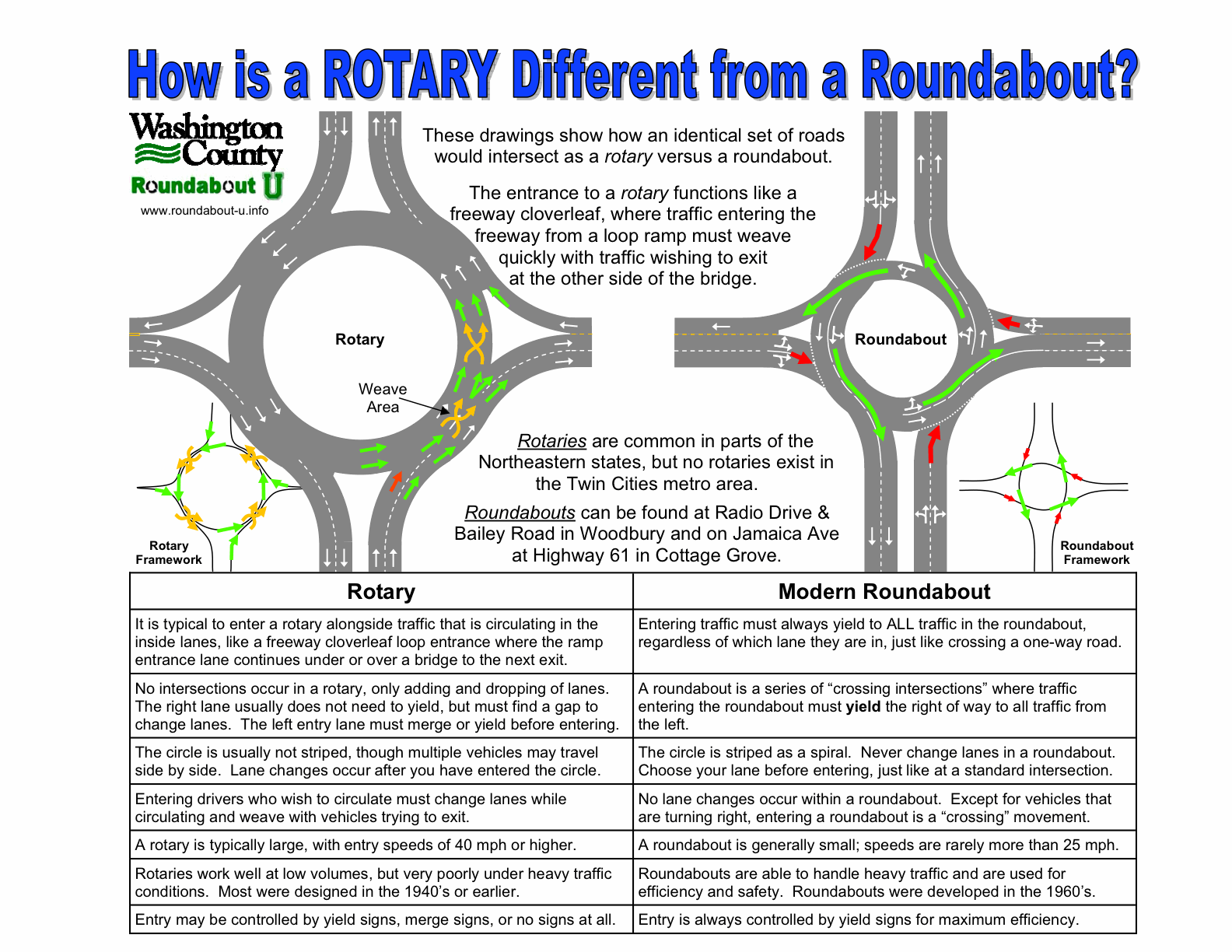
Roundabout for Eastman Ln/North Pleasant St -- May 4, 2010 Hearing
Updates: Charlie Moran of Public Works Committee reminds me that *ours* is a ONE lane roundabout, so even easier! And Guilford pointed out these are UMass' materials, not from our Amherst DPW. avb
From: Alisa Brewer
Sent: Monday, April 26, 2010 2:12:56 PM
To: Mooring, Guilford
Cc: Select Board; Stephen Braun; Crowner, Rob; Charlie Moran
Subject: Roundabout Additional Handouts beyond the Excellent DPW Materials re: Eastman Ln North Pleasant St intersection May 4, 2010 hearing
Auto forwarded by a Rule
From: Alisa Brewer
Sent: Monday, April 26, 2010 2:12:56 PM
To: Mooring, Guilford
Cc: Select Board; Stephen Braun; Crowner, Rob; Charlie Moran
Subject: Roundabout Additional Handouts beyond the Excellent DPW Materials re: Eastman Ln North Pleasant St intersection May 4, 2010 hearing
Auto forwarded by a Rule
Hi Guilford!
Beyond the excellent DPW materials for Eastman Ln / N Pleasant St
Intersection > Conceptual Plans and Comments here:
Intersection > Conceptual Plans and Comments here:
*I* find the two attachments from:
to also be very useful...I had no experience with rotaries 'til I moved to MA, and seeing even more distinct differences between the rotary and the roundabout (and the traffic circle!) than is already described in the excellent powerpoint on the project website was really helpful to me. So you may want to have copies made for the hearing on May 4, and add them to the project website, too.
I'm just sayin'
:-)
Take care,
Alisa
whose menagerie includes an impatient adult bicyclist trying to get to UMass, a 77 year old mother-in-law, and a 16 year old learner's permit-holding son within a block of this intersection:-)
Alisa
whose menagerie includes an impatient adult bicyclist trying to get to UMass, a 77 year old mother-in-law, and a 16 year old learner's permit-holding son within a block of this intersection:-)

Subscribe to:
Posts (Atom)