"We can no longer afford for-profit health care in this state," said Randy Phillis, a faculty member of the biology department at UMass Amherst. "It is literally sucking the life out of all of us and it is a huge waste of money."
Published on GazetteNET (http://www.gazettenet.com)
Source URL: http://www.gazettenet.com/2010/05/18/lawmakers-see-no-chance-reversing-state-aid-cuts
Lawmakers see no chance of reversing state aid cuts
By Owen Boss Created 05/18/2010 - 04:17
NORTHAMPTON - Supporters of a Proposition 2½ override seeking a boost in state aid to cities and towns got little encouragement from area legislators at a meeting Monday night.
More than 60 people turned out for the meeting, which was sponsored by Yes!Northampton, a nonprofit group that emerged in support of recent Proposition 2½ overrides in the city, at the Community Room at JFK Middle School. Many called on Sen. Stan Rosenberg, D-Amherst, and Rep. Peter Kocot, D-Northampton, to support bills that would restore the state tax rate on income and dividends to 12 percent, while exempting income of seniors, a plan members said would generate an estimated $500 million a year, almost exclusively from those at the top 5 percent of Massachusetts earners.
Although both Rosenberg and Kocot said that kind of legislation would help ease budget shortfalls on cities and towns statewide, they said the idea was not realistic given the commonwealth's current political climate. Kocot said the current budget crisis is bigger than any other in the recent past.
"The last two recessions, which were both described as the worst recessions since the Great Depression, lasted four and five years respectively and during those two recessions we had between a $4 billion and $6 billion problem," Kocot said. "Last year alone we dealt with a $5 billion gap and over the 22 months since the beginning of this recession, we've had a $9 billion problem to solve. This is beyond anything that we have ever faced."
Before passing out a documented roll call vote showing that only nine of 160 House member supported legislation to restore the tax rate to 12 percent, Kocot explained how legislators bridged a $5 billion budget gap in last year's budget and how they plan to close an estimated $2.7 billion in the upcoming fiscal year.
"I don't want to raise anyone's taxes. That is not the fun part of my job. But clearly, every community has needs and we need to raise additional revenues just to fund the basic services that we offer," Kocot said. "Clearly, 9/11, the meltdown on Wall Street, the wars that we have been waging in Afghanistan and Iraq have all diverted a great amount of revenue from this community and from the commonwealth."
Rosenberg shared Kocot's belief that an income tax increase would be extremely difficult to pass in the state Senate and referenced a similar vote this year to restore the state income tax to 5.7 percent.
"We had 11 out of 40 senators who voted in favor of that bill," Rosenberg said. "So the analysis that Peter gave you is a essentially consistent with what happened in the Senate and with what we can conceive happening going forward."
Rosenberg also mentioned that many state senators have vowed not to vote for new taxes in the 90 days remaining in the current term and others have said they won't vote for new taxes until the debate surrounding expanded gaming in the commonwealth is resolved.
"The problem there is that expanded gaming, if it passes, would mean we would see revenue 18 to 24 months down the road at a minimum," Rosenberg said. "Casinos or slot machines at race tracks are not going to save our hides for Fiscal '11 and the revenues they would generate would barely be visible on the budget for Fiscal '12."
Another problem with passing the legislation in time for this year's budget, Rosenberg said, is that the Senate can't enact new taxes or tax increases because the House didn't address taxes, and "all money bills and revenue bills by law have to start in the House."
Mayor Clare Higgins praised Kocot's and Rosenberg's efforts to limit reductions in state aid but drew applause from the crowd when she said not enough has been accomplished with the city facing a $480,000 cut in state aid.
"We all have to take it upon ourselves to call our state legislators and to ask them to look at how we do this because I think the whole system is fundamentally broken and I don't think it works anymore." Higgins said. "The amount of state revenue that comes back to us doesn't cover the base-line costs for things people expect to get on a local level, including street lighting, street paving, education and public safety. We can't afford to do all of those things with the amount of money coming in."
Other ideas raised at the meeting included eliminating the sales tax exemption on candy, soda, which could generate an estimated $51.7 million annually for public health programs; ending the tax exemption on cigars, smoking and smokeless tobacco; and taxing revenues generated at hospitals statewide.
"We can no longer afford for-profit health care in this state," said Randy Phillis, a faculty member of the biology department at UMass Amherst. "It is literally sucking the life out of all of us and it is a huge waste of money."
Owen Boss can be reached at oboss@gazettenet.com
Daily Hampshire Gazette © 2010 All rights reserved
Photos here:
http://www.facebook.com/album.php?aid=61893&id=1354127943
http://www.facebook.com/avbrewer
I can't find Yes!Northampton's url for some silly reason (voteyesnorthampton.org dead), but here's the Amherst:
http://voteyesforamherst.org/
--------------------------------------------------------
Published on GazetteNET (http://www.gazettenet.com)
Source URL: http://www.gazettenet.com/2010/05/15/residents-have-say-over-state039s-budget-priorities
Northampton residents to have say over state's budget priorities
By Chad Cain Created 05/15/2010 - 05:00
NORTHAMPTON - Most of Hampshire County's state legislators will pay a visit to Paradise City Monday to discuss the state budget crisis and outline steps they are taking to help communities through one of the most difficult financial times in years.
Sen. Stan Rosenberg, D-Amherst, and Reps. Peter Kocot, D-Northampton, and Ellen Story, D-Amherst, will talk about the budget and its impact on Northampton and Amherst. They also will detail solutions that exist at the state level and tout initiatives that they have put forward.
Yes!Northampton and Yes for Amherst, two fledgling groups that emerged in support of recent Proposition 2½ overrides in their communities, are sponsoring the 90-minute discussion that begins at 7 p.m. in the JFK Middle School Community Room. Northampton Mayor Clare Higgins and other elected officials will also attend.
The Yes groups are following through on promises to continue to fight to attain revenue from state and federal resources following the successful passage of overrides. They are working with One Massachusetts to develop a statewide campaign that has pushed for revenue-raising legislation that's currently being debated on Beacon Hill.
"We're really excited about this meeting," said Pamela Schwartz, a co-founder of Yes!Northampton and Ward 4 city councilor. "The answers lay beyond Northampton's borders. Our aim is to support and encourage our local legislators as they push forward on this agenda."
The meeting comes just a few days before Higgins is expected to unveil the city's fiscal 2011 budget and on the heels of a state budget approved by the House earlier this month that slices local aid to municipalities by 4 percent.
That projected cut, if it comes to fruition, would continue an eight-year trend in dwindling local aid, which in turn has forced municipalities to rely more heavily on property taxes to provide public services like education and public safety.
Schwartz notes that even though cities and towns have done all they can to balance budgets, such as raising property taxes and cutting services, not all hope is lost, especially at the state level.
A series of tax proposals being debated on Beacon Hill could make a significant difference for municipalities across the state without placing an undue burden on people who can't afford it, she said.
The package, co-sponsored by Kocot and supported by Story, includes restoring the tax rate on income and dividends to 12 percent, while exempting income of seniors. This would generate an estimated $500 million a year, almost exclusively from those at the top 5 percent of Massachusetts earners.
The proposal was overwhelmingly defeated in the House earlier this month.
Another proposal calls for eliminating the sales tax exemption on candy and soda. This would generate an estimated $51.7 million annually for public health programs. Another $15 million could come from ending the tax exemption on cigars, smoking and smokeless tobacco.
Other proposals seek legislators to re-evaluate tax breaks that would yield $84.5 million for the state. Those ideas include capping the film credit tax for one year for a $75 million savings; limiting life sciences tax credits for another $5 million; and repealing the sales tax exemption on purchases of aircraft for $4.2 million.
"There is still time to make real tax reform at a state level that can save us from local aid cuts," said Schwartz.
The meeting will also outline longer-term strategies for preventing additional state cuts to local aid in the coming years.
Yes!Northampton and Yes for Amherst view this gathering as the start of a multi-year campaign for fair tax reform that will collect adequate revenue and the protect their communities from further cuts.
Chad Cain can be reached at ccain@gazettenet.com [1].
Daily Hampshire Gazette © 2010 All rights reserved
Tuesday, May 18, 2010


Saturday, May 1, 2010
Article 16 Patterson Property – Option Agreement
As I just wrote to a friend:
If you happened to enjoy the Select Board meeting of April 26, you may have noticed we asked for more information on the Patterson project based on the variety of questions and concerns expressed in multiple venues, and we were promised we'd have it in our packets for our Monday May 3 Select Board meeting because Town Counsel was providing it to Shaffer by the end of the week. Our packets arrived via US mail today, and mine has nothing about the Patterson property in it other than the press release, Town Meeting mailing, and a map. I just called Shaffer and he said he'd get it to us Monday.
Although it was probably clear from the April 26 meeting that I've been working under the assumption that I'd recommend we pursue this project at this time, I can't give you any more reasons to do so yet. So stay tuned.
If you happened to enjoy the Select Board meeting of April 26, you may have noticed we asked for more information on the Patterson project based on the variety of questions and concerns expressed in multiple venues, and we were promised we'd have it in our packets for our Monday May 3 Select Board meeting because Town Counsel was providing it to Shaffer by the end of the week. Our packets arrived via US mail today, and mine has nothing about the Patterson property in it other than the press release, Town Meeting mailing, and a map. I just called Shaffer and he said he'd get it to us Monday.
Although it was probably clear from the April 26 meeting that I've been working under the assumption that I'd recommend we pursue this project at this time, I can't give you any more reasons to do so yet. So stay tuned.
Monday, April 26, 2010
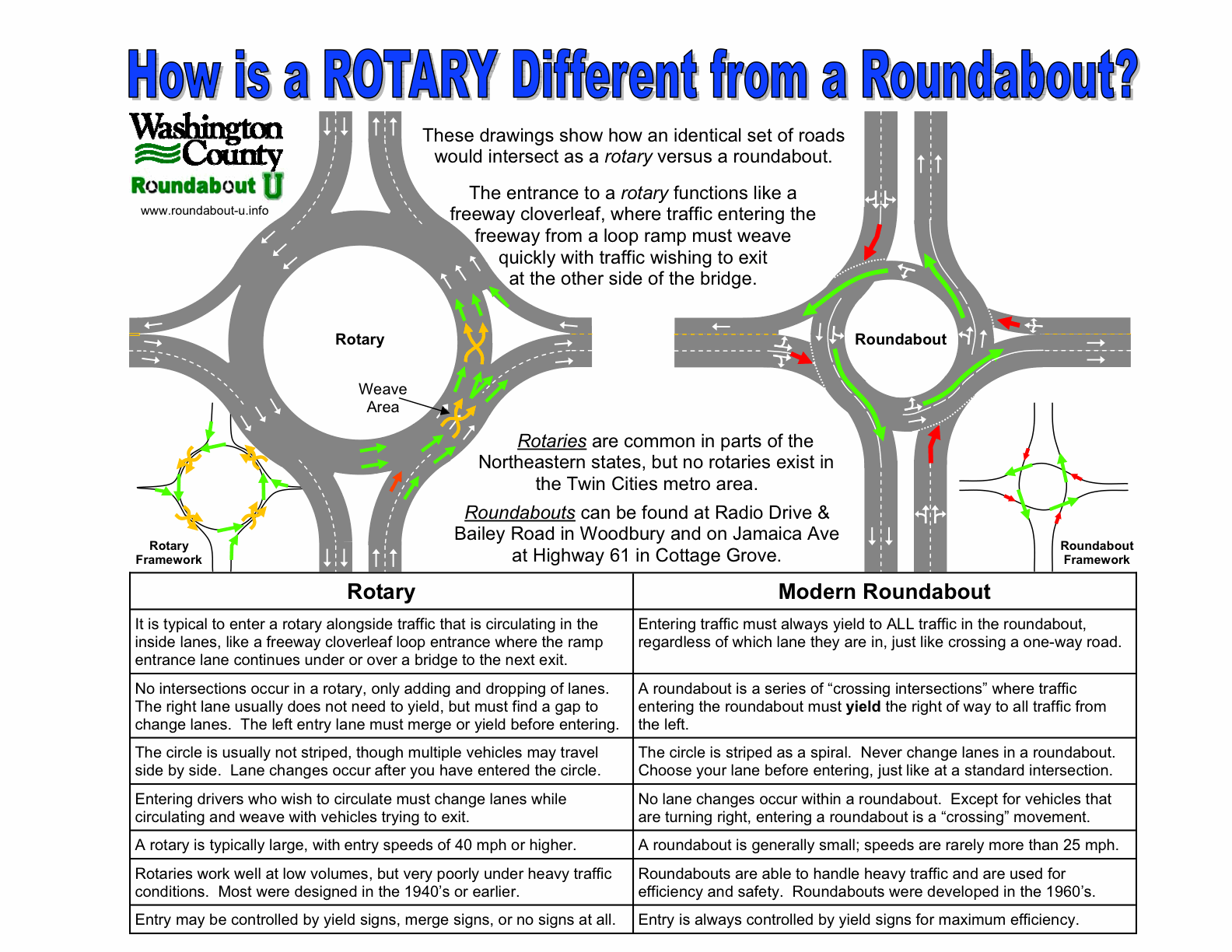
Roundabout for Eastman Ln/North Pleasant St -- May 4, 2010 Hearing
Updates: Charlie Moran of Public Works Committee reminds me that *ours* is a ONE lane roundabout, so even easier! And Guilford pointed out these are UMass' materials, not from our Amherst DPW. avb
From: Alisa Brewer
Sent: Monday, April 26, 2010 2:12:56 PM
To: Mooring, Guilford
Cc: Select Board; Stephen Braun; Crowner, Rob; Charlie Moran
Subject: Roundabout Additional Handouts beyond the Excellent DPW Materials re: Eastman Ln North Pleasant St intersection May 4, 2010 hearing
Auto forwarded by a Rule
From: Alisa Brewer
Sent: Monday, April 26, 2010 2:12:56 PM
To: Mooring, Guilford
Cc: Select Board; Stephen Braun; Crowner, Rob; Charlie Moran
Subject: Roundabout Additional Handouts beyond the Excellent DPW Materials re: Eastman Ln North Pleasant St intersection May 4, 2010 hearing
Auto forwarded by a Rule
Hi Guilford!
Beyond the excellent DPW materials for Eastman Ln / N Pleasant St
Intersection > Conceptual Plans and Comments here:
Intersection > Conceptual Plans and Comments here:
*I* find the two attachments from:
to also be very useful...I had no experience with rotaries 'til I moved to MA, and seeing even more distinct differences between the rotary and the roundabout (and the traffic circle!) than is already described in the excellent powerpoint on the project website was really helpful to me. So you may want to have copies made for the hearing on May 4, and add them to the project website, too.
I'm just sayin'
:-)
Take care,
Alisa
whose menagerie includes an impatient adult bicyclist trying to get to UMass, a 77 year old mother-in-law, and a 16 year old learner's permit-holding son within a block of this intersection:-)
Alisa
whose menagerie includes an impatient adult bicyclist trying to get to UMass, a 77 year old mother-in-law, and a 16 year old learner's permit-holding son within a block of this intersection:-)

Amherst Police Department Blog: Amherst Police Department Open House
Amherst Police Department Blog: Amherst Police Department Open House Downtown Saturday May 22nd 10 am - 2 pm
Tuesday, April 13, 2010
Lights Up! Check it out!
Check out Riverwolf Production's newest: Lights Up! In the Valley -- available at Livestream & soon On Demand at ACTV! I was of course at Select Board last night, but I heard the premiere went out on many local cable stations, not just in Amherst.
 Remember this is not a school-sponsored event, and is done entirely on the kids own time -- most are tenth graders, and all of them participate in some combination of music ensembles, dramatic performances throughout the valley, part time jobs, and a variety of sports at the same time! And in case you wondered, I am unaware of *any* adults having any input to any of the decisions made by these amazingly talented students -- aside from suggesting they add caption/lyric to the beginning of the closing song, so us old people could hear all the words:-) -- thanks!!
 Remember this is not a school-sponsored event, and is done entirely on the kids own time -- most are tenth graders, and all of them participate in some combination of music ensembles, dramatic performances throughout the valley, part time jobs, and a variety of sports at the same time! And in case you wondered, I am unaware of *any* adults having any input to any of the decisions made by these amazingly talented students -- aside from suggesting they add caption/lyric to the beginning of the closing song, so us old people could hear all the words:-) -- thanks!!
Thursday, April 1, 2010
TONIGHT! ARMS Library: Middle School Principal Finalists Public Forums April 1, 2010 start 6:30
Note the update: the third, Goodhind, dropped out Wednesday. The first set of info below is from the ARHS website, then some links from my Googling:-) I'm sorry I don't have anything to link to for Michael Hayes beyond what's on the ARHS Middle School Principal Search pages.
The public forums will be held in the Middle School library on the evening of April 1 at the following times:
Karsten Schlenter 6:30 - 7:15 p.m.
Michael Hayes 7:15 - 8:00 p.m.
We invite all members of the community to attend the forums and provide input into this very important decision for our school district.
For more information about the search
My brief Google of Karsten Schlenter of Swan Valley Middle School provided his detailed website & P.R.I.D.E.
Note this section that addresses why Michigan -> Massachusetts:
What happened to school funding in Michigan?
The following web cast explains what has occurred since 1994, when a proposal was approved by the voters (Proposal A) that shifted the primary source of school funding from property taxes (at the local level) to sales taxes (at the state level).
This web cast addresses in detail why most school districts in the state are currently experiencing severe financial hardships and are being forced to make major cuts.
This web cast does take several minutes to download and is about 16 minutes in length.
Why is this important?
Since I am currently employed in a smaller size school district, I have the least seniority in my small administrative bargaining unit and therefore fear potential lay offs in the future. I have genuinely enjoyed working for the Swan Valley School District for the past 9 years. However, as a father of 3 children I can't take such a risk at this stage of my career.
and some other positions he's seeking:
McCall Middle School, Winchester, MA
Winchester update: failed search
Frederick H Tuttle Middle School, South Burlington, VT
South Burlington process
The public forums will be held in the Middle School library on the evening of April 1 at the following times:
Karsten Schlenter 6:30 - 7:15 p.m.
Michael Hayes 7:15 - 8:00 p.m.
We invite all members of the community to attend the forums and provide input into this very important decision for our school district.
For more information about the search
My brief Google of Karsten Schlenter of Swan Valley Middle School provided his detailed website & P.R.I.D.E.
Note this section that addresses why Michigan -> Massachusetts:
What happened to school funding in Michigan?
The following web cast explains what has occurred since 1994, when a proposal was approved by the voters (Proposal A) that shifted the primary source of school funding from property taxes (at the local level) to sales taxes (at the state level).
This web cast addresses in detail why most school districts in the state are currently experiencing severe financial hardships and are being forced to make major cuts.
This web cast does take several minutes to download and is about 16 minutes in length.
Why is this important?
Since I am currently employed in a smaller size school district, I have the least seniority in my small administrative bargaining unit and therefore fear potential lay offs in the future. I have genuinely enjoyed working for the Swan Valley School District for the past 9 years. However, as a father of 3 children I can't take such a risk at this stage of my career.
and some other positions he's seeking:
McCall Middle School, Winchester, MA
Winchester update: failed search
Frederick H Tuttle Middle School, South Burlington, VT
South Burlington process
Monday, March 22, 2010
TONIGHT! Sixth Grade Families Orientation at Middle School
We're to arrive at 6:45 for 7:00 start! Program scheduled for 7:00 pm - 8:30 pm
Sixth grade families are reminded that the Middle School will be holding an orientation session this evening for parents/guardians, beginning at 7:00 pm. Please plan to attend so you can hear about all the great things in store for your rising 7th grader!
(yes, this is the one from Feb 24 where we got snowed out!)
Sixth grade families are reminded that the Middle School will be holding an orientation session this evening for parents/guardians, beginning at 7:00 pm. Please plan to attend so you can hear about all the great things in store for your rising 7th grader!
(yes, this is the one from Feb 24 where we got snowed out!)
Sunday, March 7, 2010
School Committee Candidates: Five Candidates, Two Seats, Two Votes
Thursday, March 11th, noon - 1 pm, Middle School: Amherst Regional Middle School (ARMS) Family-School Partnership hosts Brown Bag Lunch with all five candidates
Thursday, March 11th, 7 pm coffee, program begins promptly 7:30 pm - 9 pm, Middle School Auditorium: League of Women Voters Amherst asks all town-wide office candidates to respond to a series of questions, including some submitted by audience members. On ACTV live Channel 17 & repeats.
and more places on ACTV Channel 12 to listen/view the School Committee candidates:
"Student News Special" taped 03-04-10 starts broadcasting Monday March 8 at 7 pm.
(three candidates of five; *seven* questions -- which is way more than the LWV forum does)
& hopefully soon on demand
plus a 30-minute-per-candidate interview with Isaac BenEzra, Conversations, usually Wednesdays at 7 pm (the ACTV site doesn't yet list these specifically)
Candidate websites, listed in order they appear on the Tuesday March 23 Ballot:
Kathleen Dequence Anderson
Ernest J. Dalkas (no website found)
Robert A. Spence
Richard Blake Hood
Vincent J. O'Connor (no website found)
Thursday, March 11th, 7 pm coffee, program begins promptly 7:30 pm - 9 pm, Middle School Auditorium: League of Women Voters Amherst asks all town-wide office candidates to respond to a series of questions, including some submitted by audience members. On ACTV live Channel 17 & repeats.
and more places on ACTV Channel 12 to listen/view the School Committee candidates:
"Student News Special" taped 03-04-10 starts broadcasting Monday March 8 at 7 pm.
(three candidates of five; *seven* questions -- which is way more than the LWV forum does)
& hopefully soon on demand
plus a 30-minute-per-candidate interview with Isaac BenEzra, Conversations, usually Wednesdays at 7 pm (the ACTV site doesn't yet list these specifically)
Candidate websites, listed in order they appear on the Tuesday March 23 Ballot:
Kathleen Dequence Anderson
Ernest J. Dalkas (no website found)
Robert A. Spence
Richard Blake Hood
Vincent J. O'Connor (no website found)
Saturday, March 6, 2010
Nominate the Amherst Town Common as one of 1,000 Great Places in MA
The Massachusetts Office of Travel and Tourism (MOTT) has established a website to accept nominations from the public for 1,000 Great Places in Massachusetts. All Great Places that are nominated must be open and available to the public. Only one 50-word nomination per person is accepted, and you have to give them an email address in order to nominate someplace.Nomination period closes April 1, 2010. The Commission will meet later that month to draw up a final list, which will be announced in May.
I nominated the Amherst Town Common under the last category, something like "Other" :-)
Wednesday, February 17, 2010

Friday, February 12, 2010

Thursday, February 11, 2010
Speak now re: Override Question on the March 23, 2010 Ballot
BCG's February 10, 2010 recommendation to the Select Board:
Shall the Town of Amherst be allowed to assess an additional $1,765,441 in real estate and personal property taxes for the purposes of funding the following expenses: Town Operating Budget ($537,252), Elementary Schools Operating Budget ($400,000), Regional School District Assessment ($739,195), and Libraries Operating Budget ($88,994) for the fiscal year beginning July 1, 2010?
So for those of you who didn't notice me mentioning this at the Monday Feb 8, 2010 Select Board meeting: If you have an opinion on the March 23 ballot question itself, speak now via email to selectboard@amherstma.gov -- we're signing off on the language tomorrow morning Friday Feb 12, 2010 at an 8:30 am meeting at which there will be no time set aside for public comment.
Shall the Town of Amherst be allowed to assess an additional $1,765,441 in real estate and personal property taxes for the purposes of funding the following expenses: Town Operating Budget ($537,252), Elementary Schools Operating Budget ($400,000), Regional School District Assessment ($739,195), and Libraries Operating Budget ($88,994) for the fiscal year beginning July 1, 2010?
So for those of you who didn't notice me mentioning this at the Monday Feb 8, 2010 Select Board meeting: If you have an opinion on the March 23 ballot question itself, speak now via email to selectboard@amherstma.gov -- we're signing off on the language tomorrow morning Friday Feb 12, 2010 at an 8:30 am meeting at which there will be no time set aside for public comment.
Thursday, February 4, 2010
Four Towns Meeting this Sat Feb 6, 2010 9:00 am ARMS Lib
Four-Towns Meeting
Saturday, February 6, 2010
9:00 a.m. – 12:00 p.m.
Amherst Regional Middle School Library
Welcome and Introductions
Reports from Boston—Senator Stan Rosenberg (and Rep Story may attend, while Rep Kulik has a prior engagement)
Updated Revenue Assumptions and Budget Projections
State Funding
Use of E&D Funding
Use of School Choice Funding
Potential Cuts to Level Services in the FY2011 Budget
Assessments to Member Towns
FY2011 Scenarios
Projected Member Town Assessment % for FY11-16
Guidance from Member Towns
Assessments & Budget Support
Town Meeting Calendar
Warrant Articles Due Dates
Adjournment
to WinterFest!!
Monday, November 30, 2009
More H1N1 Immunization Clinics: Now for ages 6 mos to 65 years, Wed Dec 2 @UMass Campus Ctr Audit, Sat Dec 12 @Bangs
More H1N1 Immunization Clinics: Now for ages 6 mos to 65 years, Wed Dec 2 @UMass Campus Ctr Audit and Sat Dec 12 @Bangs
Please note: Clinics are open to ages 6 months – 65, while supplies last.
More info:
http://www.umass.edu/uhs/services/publichealth/
http://www.amherstma.gov/
http://www.amherstma.gov/DocumentView.aspx?DID=2874

Please note: Clinics are open to ages 6 months – 65, while supplies last.
More info:
http://www.umass.edu/uhs/services/publichealth/
http://www.amherstma.gov/
http://www.amherstma.gov/DocumentView.aspx?DID=2874
Tuesday, November 10, 2009
H1N1 Immunization Clinic for Amherst kids Wednesday 11-11-09 @ARMS 9 am - 1 pm
If your pediatrician/obstetrician still doesn't have H1N1 immunizations available (like Amherst Pediatrics doesn't for all their patients yet:-( check out the H1N1 Immunization Clinic for Amherst kids Wednesday 11-11-09 @ARMS 9 am - 1 pm.
Q: Who can get the H1N1 immunization at this clinic tomorrow, Wednesday 11-11-09?
A: Only people who fall into one of these three categories:
1. Amherst residents who are pregnant
2. Amherst residents living with an infant younger than 6 months
3. Amherst & Amherst-Pelham schools students from Amherst, Pelham, Leverett, or Shutesbury who are age 17 and under (must be accompanied to the clinic by their parent or guardian)
Q: What should I do if I need a ride to the H1N1 clinic at the Middle School?
A: Call the hotline, 413-259-3075
Q: How much does it cost?
A: Free! No payment will be accepted at the clinic, however, please bring your insurance information so that the Town can recover some costs of providing this clinic
Q: What paperwork should I bring other than my insurance card information?
A: Download this form from the Town website or the schools website or pick it up from any Amherst public school, Town Hall, or the Bangs Center. Complete as much of the form as you can before you get in line at the clinic so that things move more quickly.
Q: Will my child get the nasal spray or the shot?
A: Most will get the nasal spray. See the information sheets for the nasal spray (live virus) and the shot (inactivated)
Q: My child was already sick with what everyone says was probably H1N1 -- should my child still get the H1N1 vaccine?
A: If your child was diagnosed with H1N1 based on an H1N1 test, then your child does not need the vaccine. If your child was assumed to have H1N1, but no test was taken, then your child should still get the vaccine. This is also applies to pregnant women and adults living with infants younger than 6 months.
Q: Will this immunization clinic provide H1N1 and seasonal flu immunizations?
A: No. This clinic is for H1N1 immunizations only.
Q: I'd rather drop my child off with the paperwork -- is this OK?
A: No. All children must be accompanied by their parent or guardian.
Q: How long will it take to get through the line?
A: We've never done this before! Recent seasonal flu clinics held by a private company at various CVS locations had a two hour wait. Please bring the things you usually provide for your children when they have a long wait -- books, coloring/small crafts, handheld games or music players with headphones, snacks, water, etc.
Q: I have more questions. Who should I call?
A: Call the hotline, 413-259-3075
Q: Who can get the H1N1 immunization at this clinic tomorrow, Wednesday 11-11-09?
A: Only people who fall into one of these three categories:
1. Amherst residents who are pregnant
2. Amherst residents living with an infant younger than 6 months
3. Amherst & Amherst-Pelham schools students from Amherst, Pelham, Leverett, or Shutesbury who are age 17 and under (must be accompanied to the clinic by their parent or guardian)
Q: What should I do if I need a ride to the H1N1 clinic at the Middle School?
A: Call the hotline, 413-259-3075
Q: How much does it cost?
A: Free! No payment will be accepted at the clinic, however, please bring your insurance information so that the Town can recover some costs of providing this clinic
Q: What paperwork should I bring other than my insurance card information?
A: Download this form from the Town website or the schools website or pick it up from any Amherst public school, Town Hall, or the Bangs Center. Complete as much of the form as you can before you get in line at the clinic so that things move more quickly.
Q: Will my child get the nasal spray or the shot?
A: Most will get the nasal spray. See the information sheets for the nasal spray (live virus) and the shot (inactivated)
Q: My child was already sick with what everyone says was probably H1N1 -- should my child still get the H1N1 vaccine?
A: If your child was diagnosed with H1N1 based on an H1N1 test, then your child does not need the vaccine. If your child was assumed to have H1N1, but no test was taken, then your child should still get the vaccine. This is also applies to pregnant women and adults living with infants younger than 6 months.
Q: Will this immunization clinic provide H1N1 and seasonal flu immunizations?
A: No. This clinic is for H1N1 immunizations only.
Q: I'd rather drop my child off with the paperwork -- is this OK?
A: No. All children must be accompanied by their parent or guardian.
Q: How long will it take to get through the line?
A: We've never done this before! Recent seasonal flu clinics held by a private company at various CVS locations had a two hour wait. Please bring the things you usually provide for your children when they have a long wait -- books, coloring/small crafts, handheld games or music players with headphones, snacks, water, etc.
Q: I have more questions. Who should I call?
A: Call the hotline, 413-259-3075
Sunday, June 28, 2009


Monday, March 9, 2009
Regionalization Materials File Drawer
K-6 Regionalization Study Committee
Saturday, March 7, 2009
9:30-11:30 a.m.
Professional Development Center
Amherst Regional Middle School
AGENDA
1.Charge to the Committee
2.Welcome and Introduction
Maria Geryk, Interim Superintendent
Rob Detweiler, Director of Finance and Operations/Meeting Facilitator
3.Historical Perspective on Regionalization
4.Framing the Current Issue
5.Select K-6 Regionalization Study Committee Chair
6.Identify Factors to Consider
7.Perspectives from Each Town
8.Discuss the Process for Investigating the Factors to Consider
9.Committee Planning—Set Future Meeting Dates
possible next steps
1.Invite Christine Lynch from DESE to meet w/the committee
a.Suggestions for other communities to visit
2.Identify data needed to complete research/investigation
a.Share data from each town
b.Organize the factors for consideration
3.Identify resources needed to complete research/investigation
a.Facilities
b.Staff support
c.Budget
Leverett Elementary School Google Group related to Franklin County Public Education Study Committee
Together we won't
The governor plans to improve education by merging school districts. But other states have tried it - and it doesn't work.
By Elaine McArdle | March 8, 2009 Boston Globe
IN THE ONGOING effort to fix America's ailing schools, one of the most popular ideas is to shrink the number of school districts.
The country once had more than 130,000 independent districts managed by local communities. Merging them into larger units, advocates said, would lead to a more efficient system, reducing costs while offering students more opportunities and producing better academic results. This approach, part of a larger movement to standardize schools, reduced the number of districts by 90 percent between 1930 and 1970.
With budgets under fire, consolidation is again gaining traction as a way to save money. Today, more than a dozen states - including Maine and Vermont - have seriously considered or already implemented plans for fewer, larger districts. And last June, when Governor Deval Patrick of Massachusetts announced his comprehensive education reform agenda, he made consolidation a top priority. Reducing the number of districts will improve the quality of education, he has said. Virtually every district in the state is a candidate for consolidation if it's determined that merging with another district would benefit its academic performance, according to J.D. LaRock, chief policy adviser for the state education office.
But a wave of research from around the country shows that consolidation does not improve schools or lead to better academic results. Spending on education does not go down; indeed, budgets often balloon with increased transportation costs and more administrators to run enlarged districts. Consolidation leads to schools closing and to bigger schools, with less parental involvement and community participation. And, in many parts of the United States, it has led to children on unconscionable bus rides lasting several hours a day.
"There is either no advantage or actually a disadvantage to making these enormous uber-districts," says Andrew J. Coulson, director of the Center for Educational Freedom at the Cato Institute in Washington, D.C., who has conducted two major studies on consolidation. "They just don't help kids."
As a postdoctoral fellow at Harvard University several years ago, Christopher R. Berry became intrigued with the idea that district consolidation was, in his words, "arguably the most profound reform movement in 20th-century education." Yet almost no one had studied its effects on students.
Now an assistant professor at the Harris School of Public Policy Studies at the University of Chicago, Berry set out to fill that vacuum. Focusing on 1930 to 1970, the most intense period of consolidation in the United States, he found that consolidation of districts inevitably resulted in the consolidation of schools - closing schools and moving to bigger schools. With regard to student achievement, consolidation was "generally negative," he says, because dropout rates and wages earned by graduates got worse following mergers. (There was no standardized testing of student performance at the time.) His study, "Growing Pains: The School Consolidation Movement and Student Outcomes," co-authored with Martin R. West and published in 2008 in the Journal of Law, Economics, and Organization, also concluded that spending on education did not decrease following consolidation.
These findings challenged the entire consolidation movement, which was spearheaded with almost no critical inquiry by state officials and educational administrators, says Berry. "They seem to be convinced, almost as a matter of professional ideology, that bigger must be better," he says.
Several years ago, when Michigan began promoting consolidation, the Cato Institute's Coulson undertook a study there and in three other states and reached the same conclusion as Berry. If the goal is to improve academics, there is "no advantage whatsoever to either breaking up districts or consolidating districts," says Coulson. A 2007 study by Indiana University researchers found student achievement is not improved by consolidation; a 2008 study in Iowa found dropout rates did not decline after district mergers.
Proponents insist that larger districts are cheaper. In theory, big districts can achieve efficiencies of scale with lower per-pupil costs because fixed expenses are spread among a larger student body, and bigger districts have the power to negotiate better prices for supplies and utilities. But studies show the anticipated savings usually don't materialize. Like Berry's research, the Iowa study, by Brian Knight at Brown University and Nora Gordon at the University of California, San Diego, found per-pupil spending did not decrease after consolidation. It is true that very small districts - with fewer than 500 students, say - are the most expensive on a per-pupil basis, and merging them has the potential to significantly reduce per-pupil costs. But these districts represent a tiny fraction of any state's educational budget, so combining them has minimal effect on total costs, says John Yinger of Syracuse University, who in 2001 published with William Duncombe a study of district consolidation in New York State.
Moreover, there's no guarantee that consolidating even tiny districts will save money, Yinger emphasizes: The very process of consolidation is expensive, including new buildings and the often-substantial financial incentives states give to local communities to encourage mergers. Transportation costs can skyrocket with hauling kids to schools farther away. If there are cost savings, they often don't show up for a decade or more, according to Yinger, whose study was published as a working paper for the Center for Policy Research at Syracuse. Moreover, there was no indication that any money saved was funneled back into schools to improve academics, he says.
Meanwhile, Coulson has data that should give consolidation proponents real pause. If states are truly serious about cost savings, they should be focusing on breaking up big districts rather than combining smaller ones, he says. In Michigan, breaking up districts larger than 3,000 students would save the state 12 times as much as merging small ones: $363 million a year versus $31 million a year, he found. Yet there's rarely any discussion of this option, in Massachusetts or elsewhere.
Governor Patrick is on an ambitious schedule. He wants a substantial reduction in the Commonwealth's 329 districts, although he hasn't settled on the ideal number and district size, and legislation to that end will be introduced in the next year to 18 months, according to Secretary of Education Paul Reville. The governor and his administration are convinced that fewer districts will translate into better academics: each district will be larger, and larger districts perform better, they say.
In December, the governor's office released a study that found that larger districts in Massachusetts were academically outpacing smaller ones. Specifically, it found that on a continuum, districts closer to 5,000 pupils were more likely to have eighth-graders who perform better on the MCAS than smaller districts, as well as lower rates of student absenteeism.
"It's not all on one side, but there are some key indicators on which it does appear large districts have an advantage," says LaRock, primary author of the report. (The national studies on consolidation and research from other states are not particularly relevant, he argues, saying each state has a different educational structure.)
But a competing report in Massachusetts has found that small districts achieve better academic results. Last September, the Massachusetts Association of School Superintendents' Small and Rural School District Task Force completed a yearlong study that examined student performance in the Commonwealth. It found that the graduation rates in small districts were 6.5 percent higher than the state average, and small districts had a lower dropout rate and better attendance rates. Only 6 percent of small districts were considered "underperforming," compared with 20 percent statewide, according to standards set by the Massachusetts Department of Elementary and Secondary Education.
The 10th-grade MCAS is a more important indicator than the eighth-grade scores, the task force believes, and here smaller districts have an advantage. "On the 10th-grade MCAS, the small districts outperformed the midsized and large," says Nicholas Young, superintendent in Hadley and a vocal opponent of forced consolidation. "Some of the highest-performing districts are at or under 1,000 students."
If saving money is the goal, says Young, there are many studies that support effective but less-drastic approaches that keep schools in local hands, such as purchasing collaboratives, in which independent districts join together to buy supplies or utilities, or share certain teachers or administrators. In Maine, consolidation opponents are pushing this option. Reville says he is open to this approach but says it doesn't substitute for consolidation because fewer districts will lead to better schools through streamlined administration and centralized control over education.
"When we talk about thinking and acting like a school system instead of system of schools, I think of places like Maryland, where [the state superintendent of schools] can get 24 superintendents around a table a couple of times a month if she needs to talk about educational policy . . . to get everyone on the same page, to connect it with a system of higher education," Reville says. "There are operational advantages."
For more than 80 years, well-intentioned people have been trying to make schools better this way. And it seems logical.
It just doesn't work.
Elaine McArdle is a writer in Cambridge.
© Copyright 2009 The New York Times Company
local news updates
updated
Friday, 1:34 PM
From the Metro staff at The Boston Globe
School districts to study regionalization
February 27, 2009 11:00 AM Email| Comments (0)| Text size – +
By James Vaznis, Globe Staff
Financially strapped communities from Cape Cod to the Berkshires will receive state grants to study the possibility of regionalizing their school districts, which state education leaders say could lead to greater cost efficiencies.
At a press conference this morning at the public high school in Greenfield, state Commissioner of Elementary and Secondary Education Mitchell Chester announced that Greenfield's schools, along with other districts across the state, would receive the first batch of grants from a new state program that is urging regionalization. Each grant ranges between $15,000 and $25,000.
"This funding is meant to jumpstart a movement across the state to find ways for our smaller communities to work together, learn from one another and share expenses in a manner that makes sense fiscally and educationally," Chester said in a statement. "I am pleased that in a year when money is so tight we have [been] able to maintain this effort as a priority."
Greenfield, located in the western part of the state, is looking to merge its 1,500 students and eight schools with the neighboring Gill-Montague Regional School District, which has 1,000 students and five schools. Both districts have fallen upon tough financial times.
Merging the state's smallest school districts into larger entities is one of the many initiatives Governor Deval Patrick laid out in his sweeping state education overhaul effort known as the Readiness Project. The proposal calls for "dramatically reducing the number of school districts in the state" so less money is spent on administrative services and more can be spent in classrooms. All but 41 of the state's nearly 400 school districts serve fewer than 5,000 students.
Districts do not need to fully consolidate with a neighbor to yield savings. Districts could maintain independence while forming partnerships to run school buses, lunch programs, or special education services. The districts could even share superintendents and other central administrators, while keeping their districts as separate entities.
"In light of the current fiscal climate, this type of a collaborative effort is a key step towards finding a more manageable way of funding our public education system, and achieving the goal of providing all students quality education in the classroom," said state Senator Benjamin Downing.
In addition to Greenfield, districts receiving grants include: Ayer, Berkshire Hills Regional, Frontier Regional, Hadley, Harwich, Holland, Mahar Regional, Mohawk Regional, Nauset Regional, Westfield, and Boxford.
The Commonwealth Review podcast: Bob Pura talks School Regionalization
Saturday, March 7, 2009
9:30-11:30 a.m.
Professional Development Center
Amherst Regional Middle School
AGENDA
1.Charge to the Committee
2.Welcome and Introduction
Maria Geryk, Interim Superintendent
Rob Detweiler, Director of Finance and Operations/Meeting Facilitator
3.Historical Perspective on Regionalization
4.Framing the Current Issue
5.Select K-6 Regionalization Study Committee Chair
6.Identify Factors to Consider
7.Perspectives from Each Town
8.Discuss the Process for Investigating the Factors to Consider
9.Committee Planning—Set Future Meeting Dates
possible next steps
1.Invite Christine Lynch from DESE to meet w/the committee
a.Suggestions for other communities to visit
2.Identify data needed to complete research/investigation
a.Share data from each town
b.Organize the factors for consideration
3.Identify resources needed to complete research/investigation
a.Facilities
b.Staff support
c.Budget
Leverett Elementary School Google Group related to Franklin County Public Education Study Committee
Together we won't
The governor plans to improve education by merging school districts. But other states have tried it - and it doesn't work.
By Elaine McArdle | March 8, 2009 Boston Globe
IN THE ONGOING effort to fix America's ailing schools, one of the most popular ideas is to shrink the number of school districts.
The country once had more than 130,000 independent districts managed by local communities. Merging them into larger units, advocates said, would lead to a more efficient system, reducing costs while offering students more opportunities and producing better academic results. This approach, part of a larger movement to standardize schools, reduced the number of districts by 90 percent between 1930 and 1970.
With budgets under fire, consolidation is again gaining traction as a way to save money. Today, more than a dozen states - including Maine and Vermont - have seriously considered or already implemented plans for fewer, larger districts. And last June, when Governor Deval Patrick of Massachusetts announced his comprehensive education reform agenda, he made consolidation a top priority. Reducing the number of districts will improve the quality of education, he has said. Virtually every district in the state is a candidate for consolidation if it's determined that merging with another district would benefit its academic performance, according to J.D. LaRock, chief policy adviser for the state education office.
But a wave of research from around the country shows that consolidation does not improve schools or lead to better academic results. Spending on education does not go down; indeed, budgets often balloon with increased transportation costs and more administrators to run enlarged districts. Consolidation leads to schools closing and to bigger schools, with less parental involvement and community participation. And, in many parts of the United States, it has led to children on unconscionable bus rides lasting several hours a day.
"There is either no advantage or actually a disadvantage to making these enormous uber-districts," says Andrew J. Coulson, director of the Center for Educational Freedom at the Cato Institute in Washington, D.C., who has conducted two major studies on consolidation. "They just don't help kids."
As a postdoctoral fellow at Harvard University several years ago, Christopher R. Berry became intrigued with the idea that district consolidation was, in his words, "arguably the most profound reform movement in 20th-century education." Yet almost no one had studied its effects on students.
Now an assistant professor at the Harris School of Public Policy Studies at the University of Chicago, Berry set out to fill that vacuum. Focusing on 1930 to 1970, the most intense period of consolidation in the United States, he found that consolidation of districts inevitably resulted in the consolidation of schools - closing schools and moving to bigger schools. With regard to student achievement, consolidation was "generally negative," he says, because dropout rates and wages earned by graduates got worse following mergers. (There was no standardized testing of student performance at the time.) His study, "Growing Pains: The School Consolidation Movement and Student Outcomes," co-authored with Martin R. West and published in 2008 in the Journal of Law, Economics, and Organization, also concluded that spending on education did not decrease following consolidation.
These findings challenged the entire consolidation movement, which was spearheaded with almost no critical inquiry by state officials and educational administrators, says Berry. "They seem to be convinced, almost as a matter of professional ideology, that bigger must be better," he says.
Several years ago, when Michigan began promoting consolidation, the Cato Institute's Coulson undertook a study there and in three other states and reached the same conclusion as Berry. If the goal is to improve academics, there is "no advantage whatsoever to either breaking up districts or consolidating districts," says Coulson. A 2007 study by Indiana University researchers found student achievement is not improved by consolidation; a 2008 study in Iowa found dropout rates did not decline after district mergers.
Proponents insist that larger districts are cheaper. In theory, big districts can achieve efficiencies of scale with lower per-pupil costs because fixed expenses are spread among a larger student body, and bigger districts have the power to negotiate better prices for supplies and utilities. But studies show the anticipated savings usually don't materialize. Like Berry's research, the Iowa study, by Brian Knight at Brown University and Nora Gordon at the University of California, San Diego, found per-pupil spending did not decrease after consolidation. It is true that very small districts - with fewer than 500 students, say - are the most expensive on a per-pupil basis, and merging them has the potential to significantly reduce per-pupil costs. But these districts represent a tiny fraction of any state's educational budget, so combining them has minimal effect on total costs, says John Yinger of Syracuse University, who in 2001 published with William Duncombe a study of district consolidation in New York State.
Moreover, there's no guarantee that consolidating even tiny districts will save money, Yinger emphasizes: The very process of consolidation is expensive, including new buildings and the often-substantial financial incentives states give to local communities to encourage mergers. Transportation costs can skyrocket with hauling kids to schools farther away. If there are cost savings, they often don't show up for a decade or more, according to Yinger, whose study was published as a working paper for the Center for Policy Research at Syracuse. Moreover, there was no indication that any money saved was funneled back into schools to improve academics, he says.
Meanwhile, Coulson has data that should give consolidation proponents real pause. If states are truly serious about cost savings, they should be focusing on breaking up big districts rather than combining smaller ones, he says. In Michigan, breaking up districts larger than 3,000 students would save the state 12 times as much as merging small ones: $363 million a year versus $31 million a year, he found. Yet there's rarely any discussion of this option, in Massachusetts or elsewhere.
Governor Patrick is on an ambitious schedule. He wants a substantial reduction in the Commonwealth's 329 districts, although he hasn't settled on the ideal number and district size, and legislation to that end will be introduced in the next year to 18 months, according to Secretary of Education Paul Reville. The governor and his administration are convinced that fewer districts will translate into better academics: each district will be larger, and larger districts perform better, they say.
In December, the governor's office released a study that found that larger districts in Massachusetts were academically outpacing smaller ones. Specifically, it found that on a continuum, districts closer to 5,000 pupils were more likely to have eighth-graders who perform better on the MCAS than smaller districts, as well as lower rates of student absenteeism.
"It's not all on one side, but there are some key indicators on which it does appear large districts have an advantage," says LaRock, primary author of the report. (The national studies on consolidation and research from other states are not particularly relevant, he argues, saying each state has a different educational structure.)
But a competing report in Massachusetts has found that small districts achieve better academic results. Last September, the Massachusetts Association of School Superintendents' Small and Rural School District Task Force completed a yearlong study that examined student performance in the Commonwealth. It found that the graduation rates in small districts were 6.5 percent higher than the state average, and small districts had a lower dropout rate and better attendance rates. Only 6 percent of small districts were considered "underperforming," compared with 20 percent statewide, according to standards set by the Massachusetts Department of Elementary and Secondary Education.
The 10th-grade MCAS is a more important indicator than the eighth-grade scores, the task force believes, and here smaller districts have an advantage. "On the 10th-grade MCAS, the small districts outperformed the midsized and large," says Nicholas Young, superintendent in Hadley and a vocal opponent of forced consolidation. "Some of the highest-performing districts are at or under 1,000 students."
If saving money is the goal, says Young, there are many studies that support effective but less-drastic approaches that keep schools in local hands, such as purchasing collaboratives, in which independent districts join together to buy supplies or utilities, or share certain teachers or administrators. In Maine, consolidation opponents are pushing this option. Reville says he is open to this approach but says it doesn't substitute for consolidation because fewer districts will lead to better schools through streamlined administration and centralized control over education.
"When we talk about thinking and acting like a school system instead of system of schools, I think of places like Maryland, where [the state superintendent of schools] can get 24 superintendents around a table a couple of times a month if she needs to talk about educational policy . . . to get everyone on the same page, to connect it with a system of higher education," Reville says. "There are operational advantages."
For more than 80 years, well-intentioned people have been trying to make schools better this way. And it seems logical.
It just doesn't work.
Elaine McArdle is a writer in Cambridge.
© Copyright 2009 The New York Times Company
local news updates
updated
Friday, 1:34 PM
From the Metro staff at The Boston Globe
School districts to study regionalization
February 27, 2009 11:00 AM Email| Comments (0)| Text size – +
By James Vaznis, Globe Staff
Financially strapped communities from Cape Cod to the Berkshires will receive state grants to study the possibility of regionalizing their school districts, which state education leaders say could lead to greater cost efficiencies.
At a press conference this morning at the public high school in Greenfield, state Commissioner of Elementary and Secondary Education Mitchell Chester announced that Greenfield's schools, along with other districts across the state, would receive the first batch of grants from a new state program that is urging regionalization. Each grant ranges between $15,000 and $25,000.
"This funding is meant to jumpstart a movement across the state to find ways for our smaller communities to work together, learn from one another and share expenses in a manner that makes sense fiscally and educationally," Chester said in a statement. "I am pleased that in a year when money is so tight we have [been] able to maintain this effort as a priority."
Greenfield, located in the western part of the state, is looking to merge its 1,500 students and eight schools with the neighboring Gill-Montague Regional School District, which has 1,000 students and five schools. Both districts have fallen upon tough financial times.
Merging the state's smallest school districts into larger entities is one of the many initiatives Governor Deval Patrick laid out in his sweeping state education overhaul effort known as the Readiness Project. The proposal calls for "dramatically reducing the number of school districts in the state" so less money is spent on administrative services and more can be spent in classrooms. All but 41 of the state's nearly 400 school districts serve fewer than 5,000 students.
Districts do not need to fully consolidate with a neighbor to yield savings. Districts could maintain independence while forming partnerships to run school buses, lunch programs, or special education services. The districts could even share superintendents and other central administrators, while keeping their districts as separate entities.
"In light of the current fiscal climate, this type of a collaborative effort is a key step towards finding a more manageable way of funding our public education system, and achieving the goal of providing all students quality education in the classroom," said state Senator Benjamin Downing.
In addition to Greenfield, districts receiving grants include: Ayer, Berkshire Hills Regional, Frontier Regional, Hadley, Harwich, Holland, Mahar Regional, Mohawk Regional, Nauset Regional, Westfield, and Boxford.
The Commonwealth Review podcast: Bob Pura talks School Regionalization
Monday, November 3, 2008
Remember to Vote TWO Ballots in Amherst tomorrow:-)
Remember that in Amherst, you need *two* ballots tomorrow, don't forget in all the excitement! Sample Amherst ballots
How Alisa is voting on Tuesday November 4, 2008:
Aaron Hayden for Amherst Select Board
(and yes, Obama/Biden & all the incumbents)
Questions:
1. NO A No vote would make no change in state income tax laws
2. YES A Yes vote would replace the criminal penalties for possession of one ounce or less of marijuana with a new system of civil penalties
3. NO A No vote would make no change in the laws governing dog racing
4. NO so that the CPA tax is retained at 1.5%, not increased to 3%
5. YES for single payer health insurance and for not penalizing people for not buying crappy overpriced insurance (editorializing mine:-) (non-binding)
6. YES for pressuring us to do better with the greening of America, although I also understand this reason to vote No (non-binding)
How Alisa is voting on Tuesday November 4, 2008:
Aaron Hayden for Amherst Select Board
(and yes, Obama/Biden & all the incumbents)
Questions:
1. NO A No vote would make no change in state income tax laws
2. YES A Yes vote would replace the criminal penalties for possession of one ounce or less of marijuana with a new system of civil penalties
3. NO A No vote would make no change in the laws governing dog racing
4. NO so that the CPA tax is retained at 1.5%, not increased to 3%
5. YES for single payer health insurance and for not penalizing people for not buying crappy overpriced insurance (editorializing mine:-) (non-binding)
6. YES for pressuring us to do better with the greening of America, although I also understand this reason to vote No (non-binding)
Thursday, February 7, 2008
BCG FY09+ Budget Forum on Monday February 11th starting at 7 pm in the Middle School Auditorium

[copy of email sent to 433 Amherst community members]
OK, folks, attached.pdf hot of the press from the schools (coming home in backpacks on Thursday, I think).
You can also provide a link to the Town website front page, middle:
http://www.amherstma.gov/
Get it out there, please. We need lots of people *throughout Amherst* to understand what's going on if we're going to do anything other than rearrange deck chairs while we decimate the elementary schools in FY09, and we need a *plan* that gets us on track to survive (and thrive!) without some magical infusion of funds from the state and federal governments, because they are *not* coming to save us, no matter how hard we lobby them! (although yes, you still have to do the lobbying:-)
Talk to a BCG member if you have any questions; this is their show:
http://www.amherstma.gov/departments/Budget_Coordinating_Group/default.asp?id=77&mypage=77&myName=Budget+Coordinating+Group
Thanks so much for helping make our community what we all want it to be!
Take care,
Alisa
Tuesday, February 5, 2008
February 5, 2008 Primary Amherst Precinct Returns
Clinton-Obama-Other Dems
Precinct 1: 136-291-12
Precinct 2: 242-477-09
Precinct 3: 104-213-05
Precinct 4: 104-213-03 (not a typo!)
Precinct 5: 167-351-14
Precinct 6: 305-611-25
Precinct 7: 236-527-24
Precinct 8: 364-749-14
Precinct 9: 194-465-05
Precinct 10:102-242-07
Total someone:-) provided: 1954-4139-128
Precinct 1: 136-291-12
Precinct 2: 242-477-09
Precinct 3: 104-213-05
Precinct 4: 104-213-03 (not a typo!)
Precinct 5: 167-351-14
Precinct 6: 305-611-25
Precinct 7: 236-527-24
Precinct 8: 364-749-14
Precinct 9: 194-465-05
Precinct 10:102-242-07
Total someone:-) provided: 1954-4139-128
Subscribe to:
Posts (Atom)